

Petit Paris | Julie et Paul
Julie et Paul vont à l’école is the third bilingual picture book for Petit Paris. A QR code on the back cover opens a web app where the author reads every page aloud.

Overview
Sandrine Oskian writes the Julie et Paul books for Petit Paris, her French learning centres for children in Glyfada. In this one, sixteen A4 pages follow Julie and Paul through one school day, from waking up to bedtime, and every sentence appears in French and in Greek.
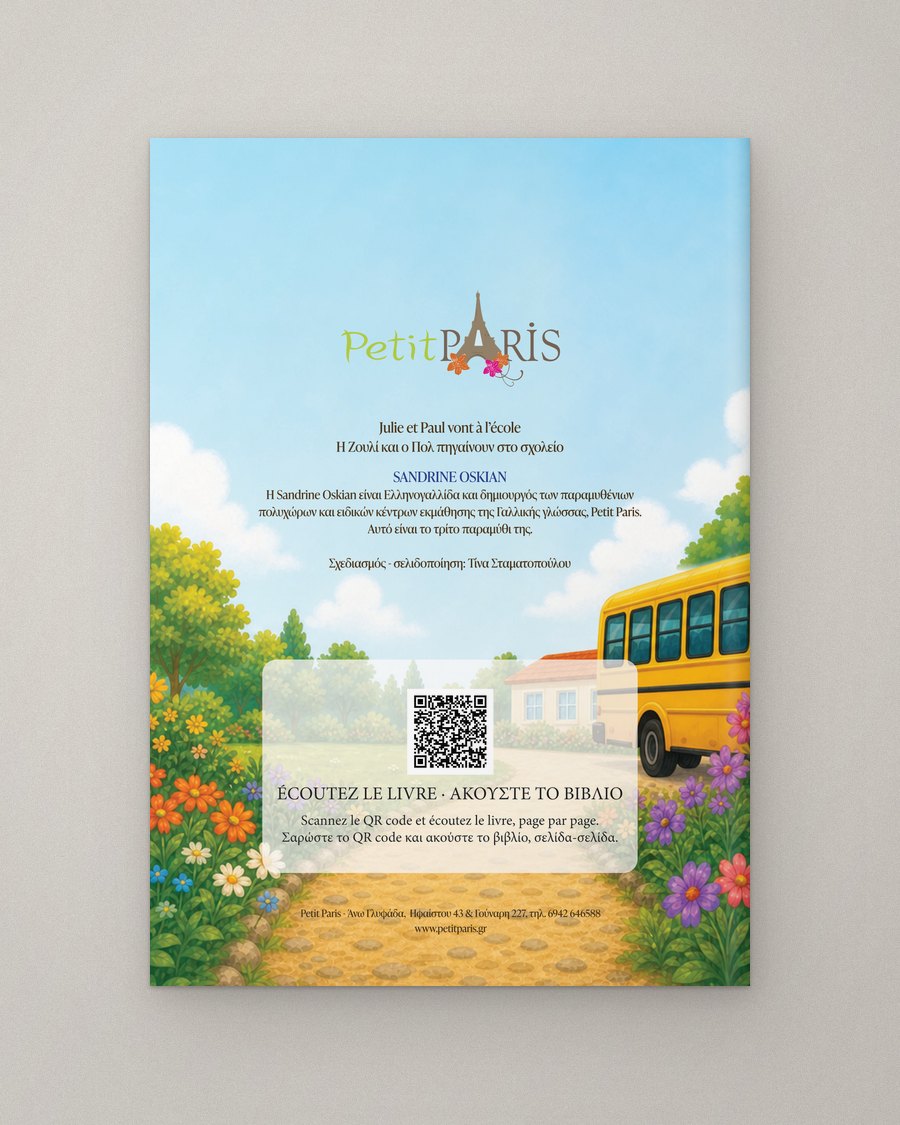
The Greek line tells a parent what the page says. It cannot tell them how it sounds. So the back cover carries a QR code that opens a web app where Sandrine reads every page aloud, in the same order as the paper.
My part covered the illustration direction, the layout and bilingual typography, the print files with spot UV on the cover title, and the web app behind the QR code.
Skills: Picture Book Layout · Bilingual Typography · AI-assisted Illustration Direction · Character Consistency · Print Production · Spot UV · QR Integration · Audio Web App · PWA
The book
One school day in seven spreads, framed by the cover. Each page holds a single sentence, so the child sets the pace.
Across the spreads, a warm page always faces a cooler one: a bedroom against a green kitchen, a pale blue hallway against a sunlit classroom.
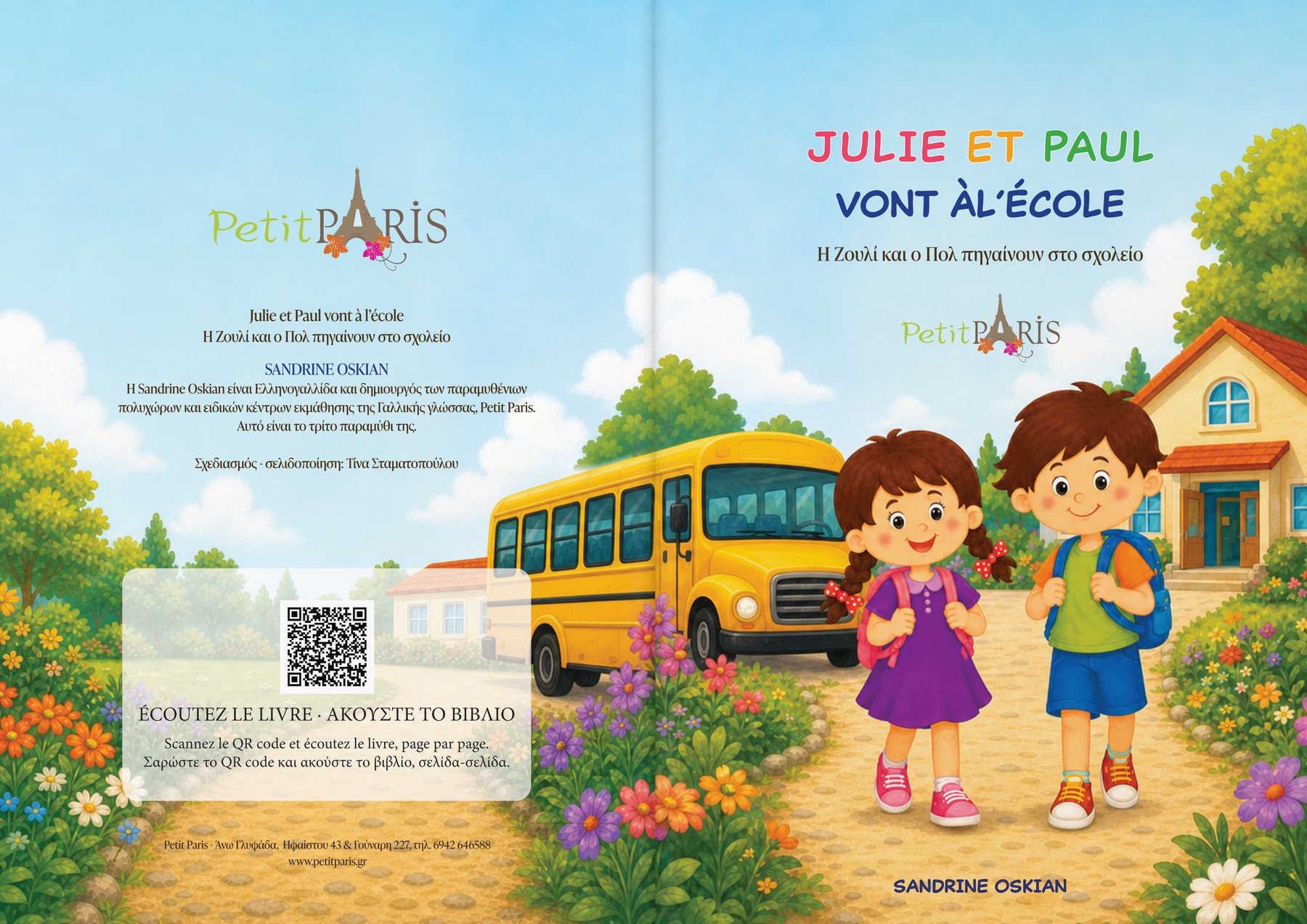
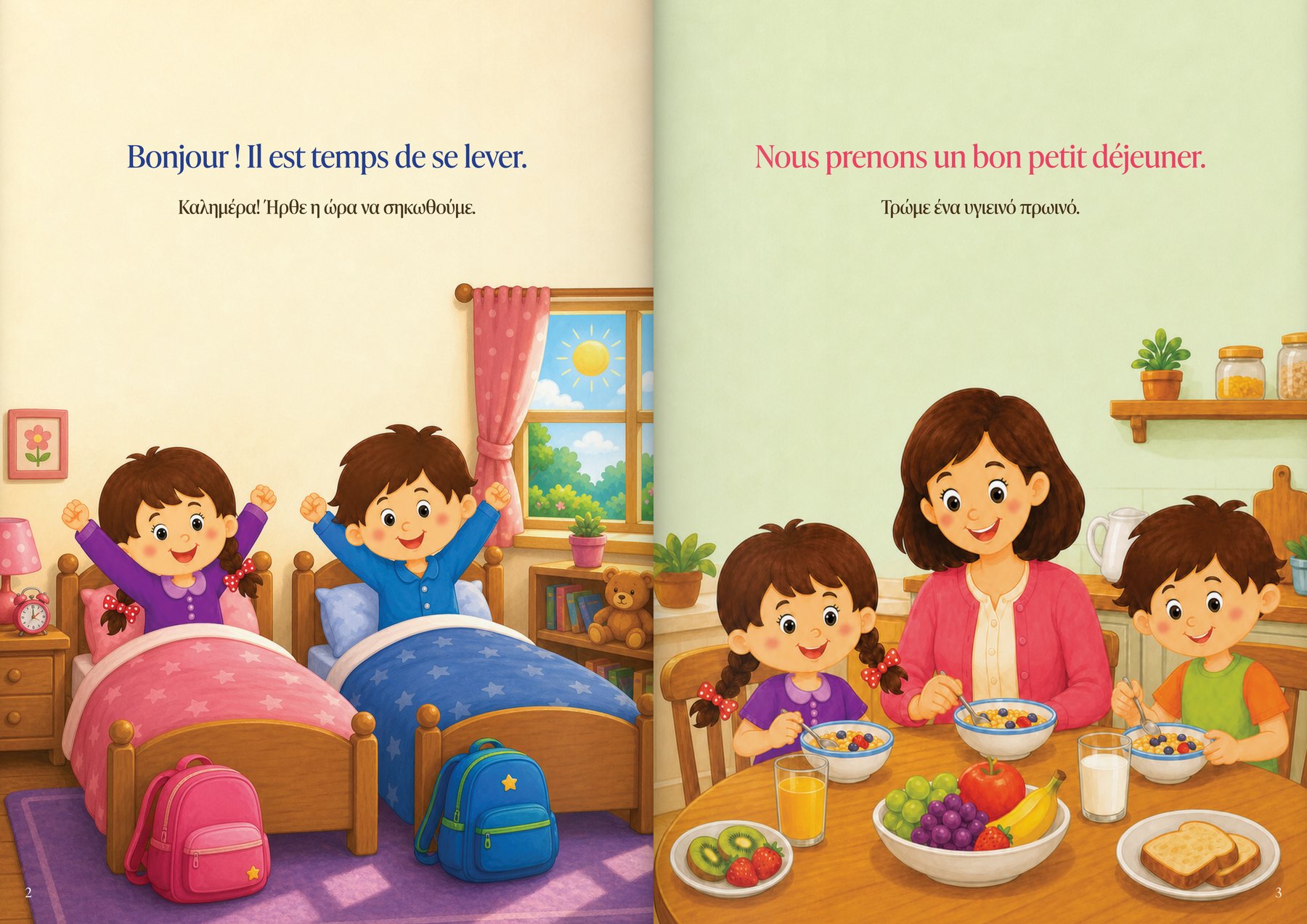
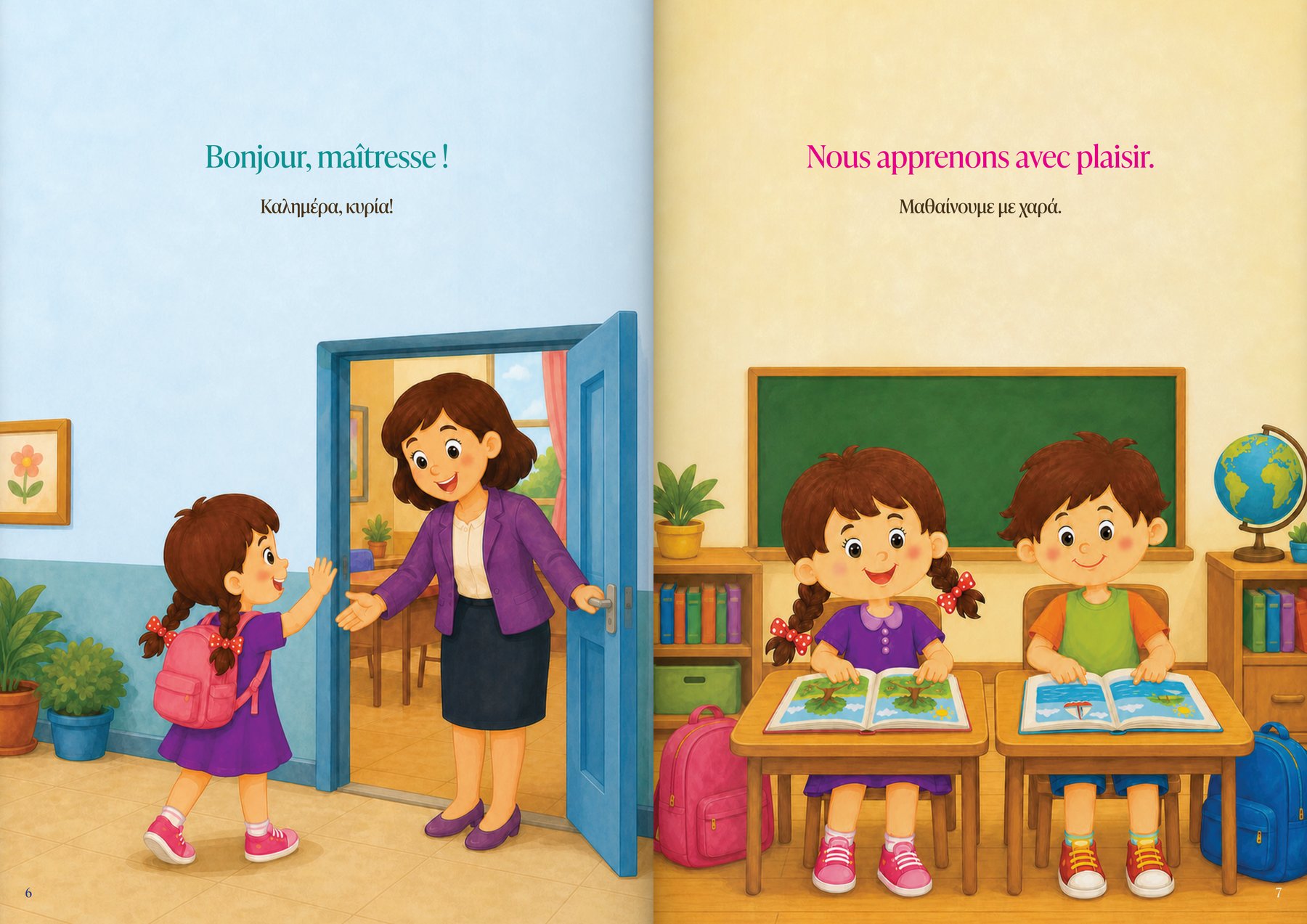
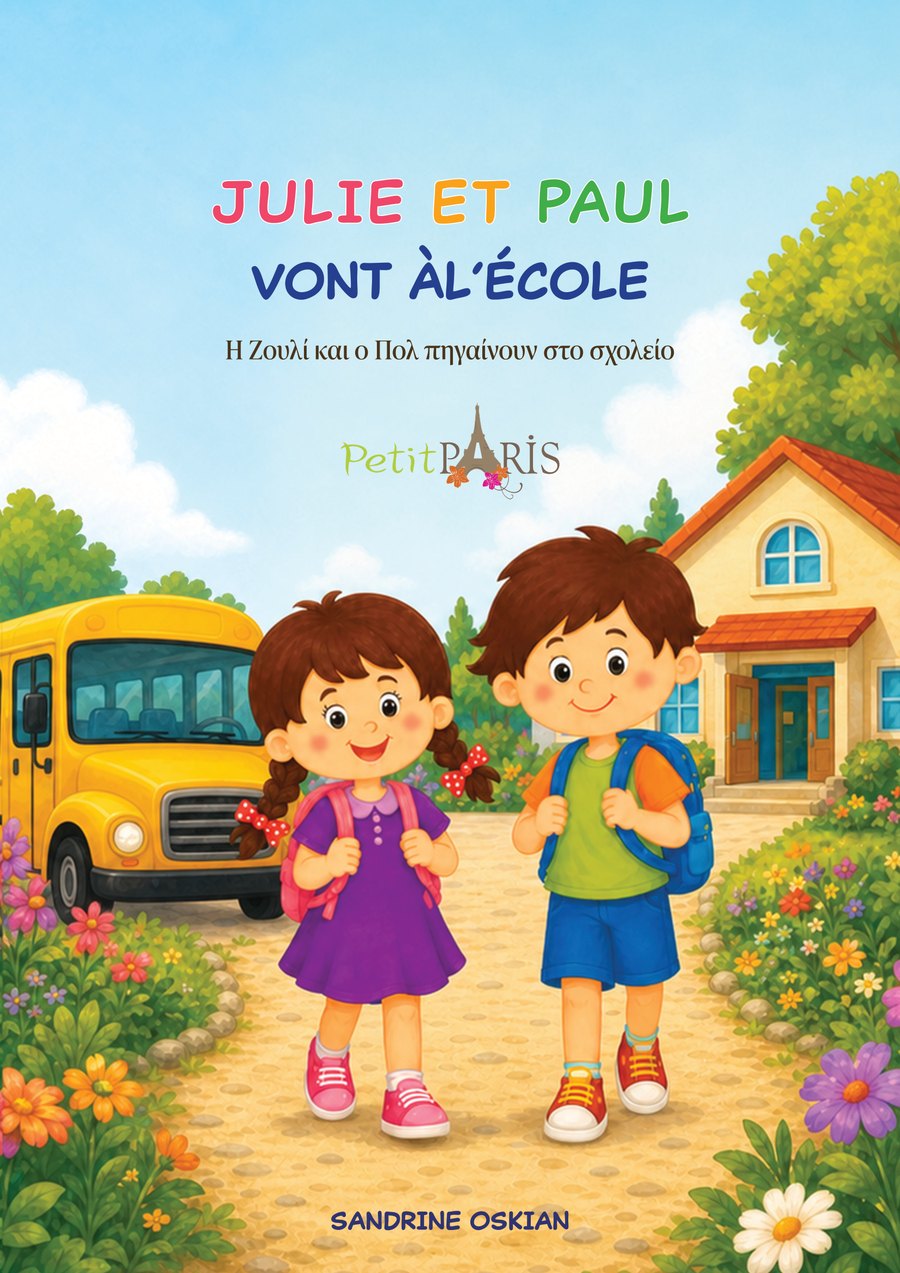
The cover and two of the seven inner spreads are shown here. The complete book is on sale at Petit Paris.
Page system
A French learning book has an unusual reader. The child cannot read the text alone, and the adult reading along may not speak the language. The page has to serve both without turning into a schoolbook.
Four rules hold on all fourteen inner pages, so the text always lands in the same place and a small reader learns where to look.
- 01Lead
French first: large, centred, in a colour picked from the scene.
- 02Support
Greek directly underneath, smaller and darker. Easy to find, never louder than the French.
- 03Reserve
The upper third of every scene stays quiet, so no face or detail ever sits under a sentence.
- 04Keep live
No lettering inside the images. Corrections and reprints happen in the layout, not in the artwork.
Illustration
The illustrations were made with AI and directed image by image. Julie and Paul already had a face from Book II, so continuity came first: a character master sheet fixed their faces, braids, clothes and backpack colours before any scene was generated.
Every scene was briefed against the page rules above: a quiet upper third, no lettering, characters readable at a glance. Two finishing rounds went back into ten of the images before the files went to press.
AI produced the drawings. Every decision about what a page shows, and what it leaves out, was mine.

Audio companion
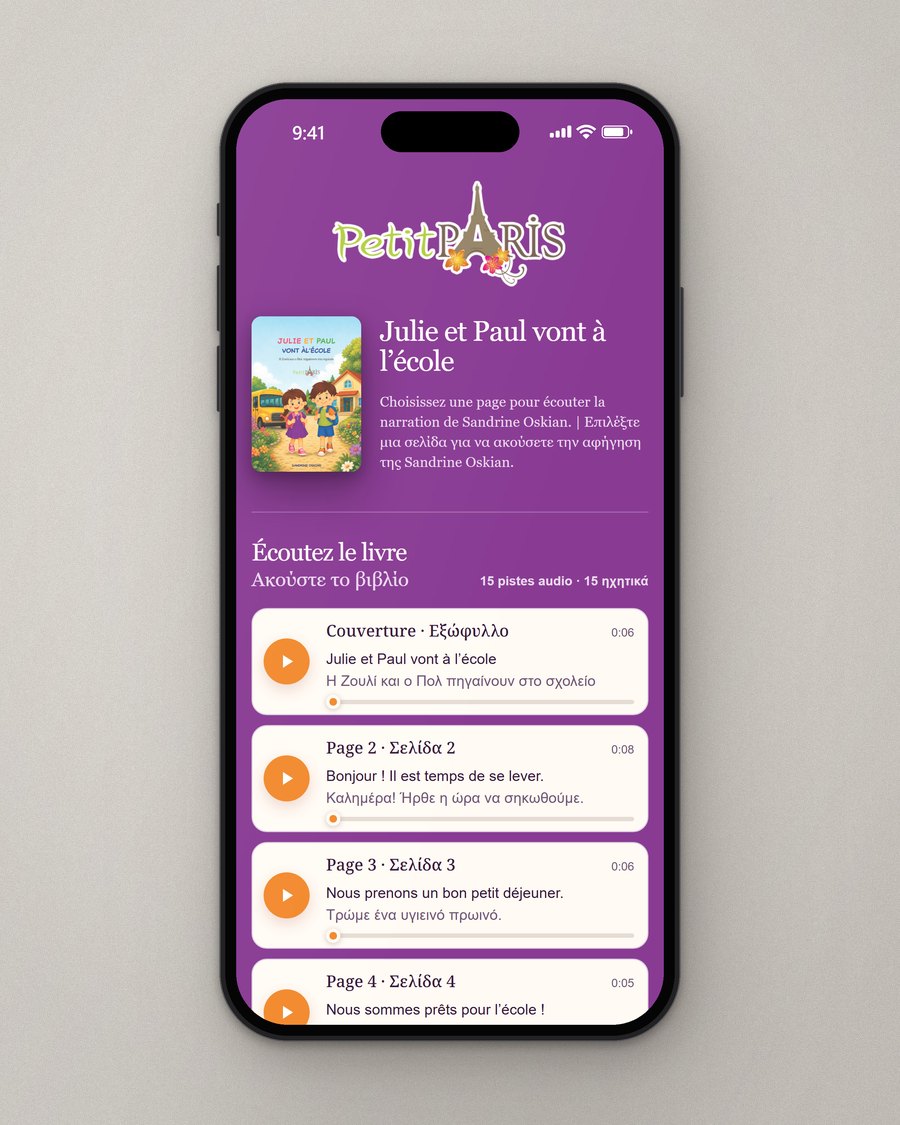
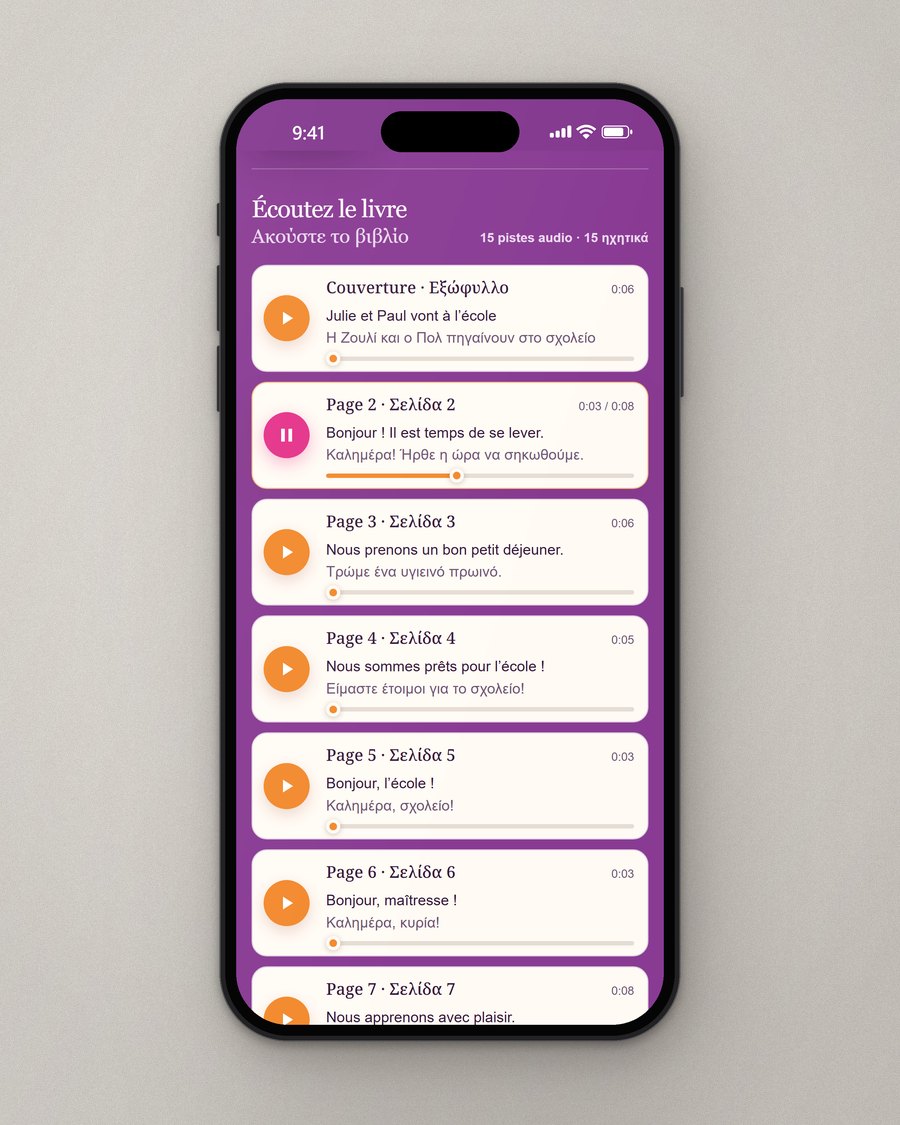
The QR code opens a single web page. Nothing to install, nothing to sign up for. Fifteen tracks mirror the paper: Couverture, then Page 2 to Page 15, each labelled in French and Greek with the sentence it reads.
One tap plays or pauses, and each page has its own progress bar. The phone’s lock screen shows the book’s artwork with playback controls. Saved to the home screen, it opens full screen like an app.
Book II’s companion runs on the same framework. Each new book gets its own address under petitparis.gr/audio and its own QR code, while the interface stays the one parents already know.
Series
Petit Paris has been my client since 2018, when I designed petitparis.gr. The books came later: Book I in 2021, where my part was the layout; Book II added the audio companion; Book III is the first where I also directed the illustrations.
The series is the real brief. A child moving from Book II to Book III should meet the same two faces and hear the story the same way.
Listen to the book
The companion is live. Scan the code with a phone, the way a family does from the back cover, or open it in the browser.
Open the audio app ↗
The app was designed as part of the book. Page numbers, sentences and cover are identical on paper and on screen, so a child holding the book and a parent holding the phone are always on the same page.